
Choosing the Right Lingerie Patterns
For the best results, choose sewing patterns designed for stretch fabrics. While some woven fabric patterns cut on the bias may work, stretch-specific patterns will give you the comfort and fit you want.
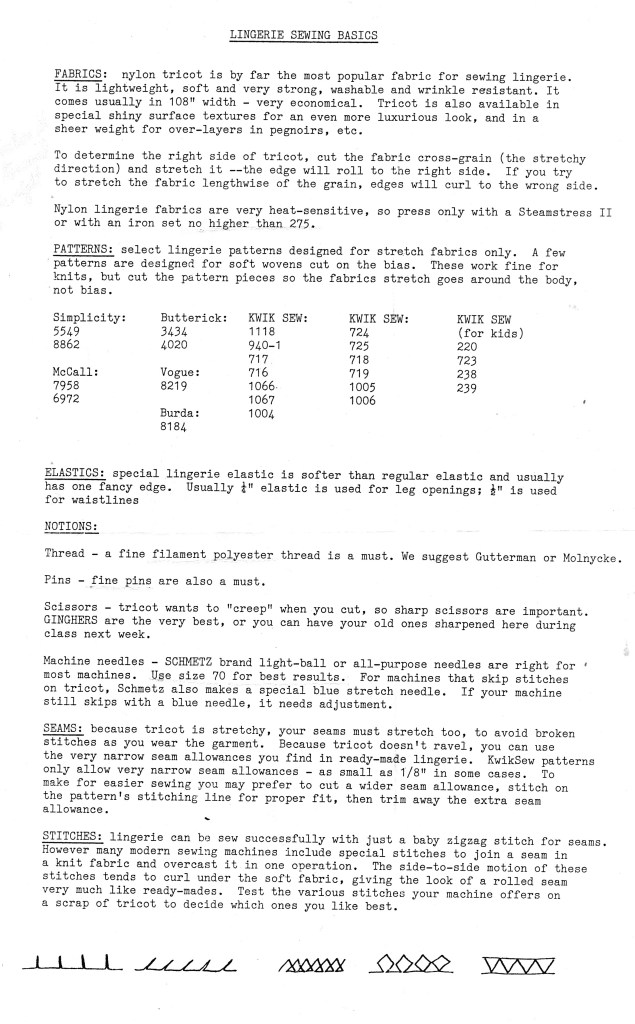
Here are some tried-and-true lingerie sewing patterns you can look up:
- Simplicity: 5549, 8862
- Butterick: 3434, 4020
- McCall’s: 7958, 6972
- Vogue: 716, 1066, 1067
- Kwik Sew: 1118, 940-1, 717, 718, 719, 1005, 1006
- Kwik Sew Kids: 724, 725, 220, 723, 238, 239
- Burda: 1004, 8184
These patterns are beginner-friendly and great starting points for sewing lingerie at home.
Lingerie Elastic: What You Need to Know
One of the biggest differences between lingerie and regular sewing is the elastic. Lingerie elastic is softer and often comes with a decorative edge.
- Use ¼-inch elastic for leg openings.
- Use ½-inch elastic for waistbands.
This small detail gives your handmade lingerie a professional finish.
Must-Have Sewing Notions
Here’s what you’ll need in your lingerie sewing toolkit:
- Thread: Use fine polyester filament thread (Gutermann or Molnlycke are great choices).
- Pins: Fine pins are best for delicate fabrics like tricot.
- Scissors: Tricot can be slippery, so invest in sharp sewing scissors (Gingher scissors are a favorite).
- Needles: A Schmetz size 70 ballpoint or all-purpose needle works well. For stretchy tricot, a Schmetz blue stretch needle may be needed.
Sewing Lingerie Seams and Stitches
Since lingerie fabrics stretch, your seams need to stretch too. Here’s how to get them right:
- Seam allowances: Tricot doesn’t fray, so you can use very narrow seam allowances (⅛” is common). For easier sewing, you can stitch with a wider allowance, then trim the excess.
- Seams: A baby zigzag stitch works great for stretchy seams.
- Special stitches: Many modern sewing machines include stretch stitches that sew and finish in one step, giving a professional look similar to store-bought lingerie.
Always test your stitch on a scrap of fabric before sewing your garment.
Applying Elastic to Lingerie
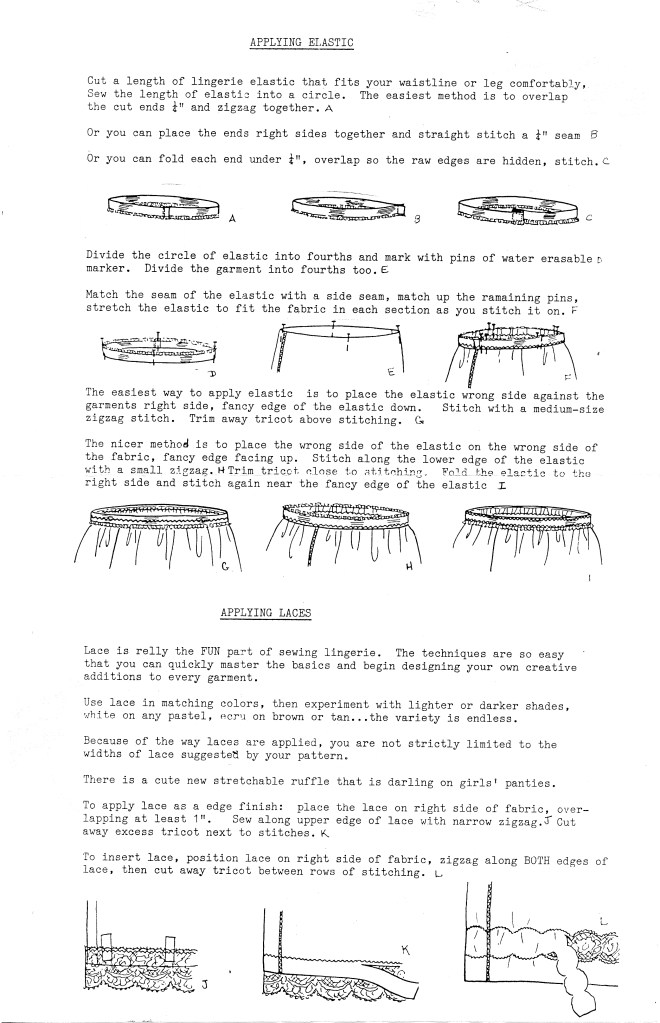
Elastic is essential in lingerie because it helps the garment stretch, fit snugly, and hold its shape. Here’s how to apply it:
Step 1: Join the Elastic into a Circle
Cut a length of lingerie elastic that fits comfortably around your waistline or leg. Then sew the ends together to make a loop. You have three options:
- Overlap the ends ½” and stitch with a zigzag (quick & easy).
- Right sides together, straight stitch with a ¼” seam.
- Fold ends under ¼”, overlap to hide raw edges, and stitch.
Step 2: Divide Elastic and Garment into Fourths
To evenly stretch the elastic as you sew, mark the elastic into four equal sections with pins (or a fabric marker). Do the same with your garment.
Step 3: Match and Sew
Pin the elastic seam to a garment seam. Match the other pins, then stretch the elastic to fit the fabric section by section as you sew.
Step 4: Stitching the Elastic
You have two main options:
- Easiest Method: Place the elastic wrong side against the garment’s right side, with the fancy edge facing down. Stitch with a medium zigzag. Trim away extra fabric above the stitching.
- Nicer Finish: Place the elastic wrong side to the fabric’s wrong side, fancy edge up. Stitch along the lower edge with a small zigzag. Trim close to the stitching, then fold the elastic over to the right side and stitch again near the decorative edge.
This second method creates a neat, professional finish.
Applying Lace to Lingerie
Lace is where you get to have fun with lingerie sewing! It’s the perfect way to add elegance and a custom touch to any piece.
Tips for Using Lace in Lingerie
- Match lace colors for a subtle look, or play with contrasts (white lace on pastels, black on brights, ecru on neutrals).
- You’re not limited to the lace widths suggested by your pattern—experiment freely.
- Try using stretch lace ruffles for panties or camisoles—they’re charming and comfortable.
Methods for Applying Lace
- Edge Finish: Place lace on the garment’s right side, overlapping the fabric edge by at least 1″. Sew along the upper edge with a narrow zigzag. Trim away excess fabric next to the stitches.
- Insert Lace (for cut-out or see-through panels): Position lace on the right side of the fabric and zigzag along both edges of the lace. Cut away the fabric behind the lace between your rows of stitching for a delicate, inset effect.
Hemline Lace with a Slit
Adding lace to the hemline of a slip or nightgown instantly gives it a polished, romantic look.
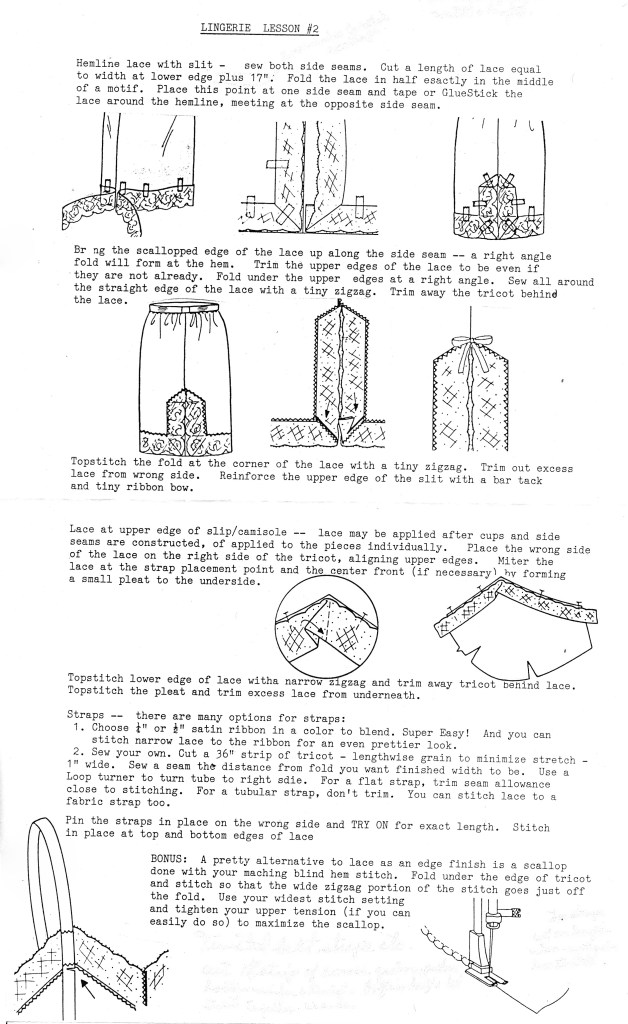
How to sew hemline lace with a slit:
- Sew both side seams of the garment.
- Cut lace the length of your hem plus 1–2 inches. Fold it exactly in half to find the center.
- Pin or tape the lace around the hem, starting at one side seam and ending at the opposite side.
- Bring the scalloped edge of the lace up along the slit opening at a right angle. Trim and fold under the upper edges neatly.
- Sew all around the lace edge with a tiny zigzag. Trim away extra tricot behind the lace for a smooth finish.
- Reinforce the top of the slit with a bar tack, and if you like, finish with a tiny ribbon bow for decoration.
Lace at the Upper Edge of a Slip or Camisole
You can add lace to the top of camisoles or slips either after construction (once the cups and side seams are sewn) or to the pieces individually before assembly.
Steps for applying lace to the upper edge:
- Place lace on the right side of tricot, aligning the top edges.
- Miter the lace at the center front and strap placement points. If needed, form a small pleat underneath for a neat fit.
- Topstitch along the lower lace edge with a narrow zigzag. Trim away tricot from underneath for a sheer lace edge.
- Topstitch pleats flat for extra reinforcement.
Sewing Straps
Straps are an essential part of lingerie, and you have multiple options depending on the look you want.
Easy Strap Options:
- Ribbon Straps: Choose ¼” or ½” satin ribbon in a matching or contrasting color. For added detail, stitch narrow lace along the ribbon edge.
- Fabric Straps: Cut a 36” strip of tricot on the lengthwise grain (to reduce stretch). Fold, stitch, and use a loop turner to turn right side out.
- For flat straps: trim seam allowance close to stitching.
- For tubular straps: don’t trim; just turn right side out.
- You can also stitch lace onto fabric straps for a delicate look.
Attaching straps: Pin them to the wrong side of the garment, try on for fit, then stitch securely at the top and bottom edges of the lace.
Bonus: Scallop Edge Finish
Want an alternative to lace? You can create a pretty scalloped hem using your machine’s blind hem stitch:
- Fold the tricot edge under.
- Stitch so the wide zigzag portion of the stitch just clears the fold.
- Use your widest stitch setting and tighten upper tension for maximum scallop effect.
This technique mimics a lace edge without actually using lace!
 girl-diy.com